
Why the Extended-Hold Breath Builds Calm, Clarity, and Real Momentum
Most people do not realize how often they are holding tension without knowing it.
Jaw clenched.
Shoulders lifted.
Breath shallow or rushed.
Mind already moving on to the next thing.
Over time, this becomes normal. And when it is normal, the body stops asking for help. It just adapts.
This is where many daily problems begin.
The common patterns we see every day
At Fire Shaper, people often arrive with similar experiences, even if they describe them differently.
-
Feeling wired but tired
-
Difficulty slowing down, even when resting
-
Trouble sleeping or waking up already tense
-
A sense of constant pressure or urgency
-
Emotional reactivity that feels out of proportion
-
Physical tightness that keeps returning no matter how much stretching is done
None of these issues mean something is broken.
They usually mean the nervous system is stuck in a state of low-level overdrive.
The body is doing its best to cope, but it has forgotten how to fully settle, organize, and reset.
Why breath matters more than effort
When stress builds, the instinct is often to try harder.
More exercise.
More stretching.
More discipline.
More productivity.
But effort alone does not calm the nervous system. In many cases, it adds to the load.
The breath is different.
Breath is one of the few tools that speaks directly to the nervous system without force. It influences heart rhythm, muscle tone, emotional regulation, and mental clarity all at once.
Not all breathing techniques do this equally.
Some stimulate.
Some release.
Some organize.
The Extended-Hold Breath is about organization.
What the Extended-Hold Breath actually does
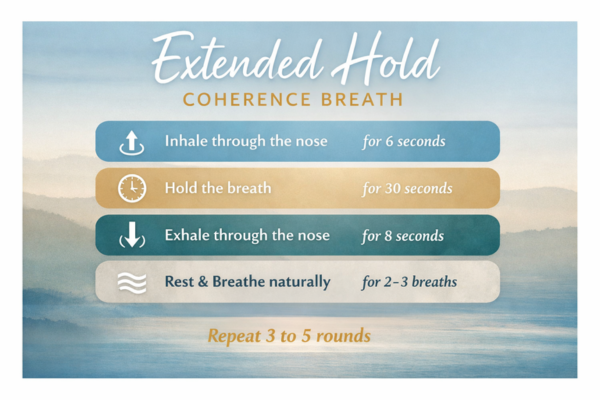
This breath uses four phases. A slow inhale, a calm hold, a long exhale, and a short rest.
The key is the hold.
A comfortable, unforced breath hold sends a powerful message to the body. It says you are safe enough to pause. Safe enough to stay present. Safe enough to stop reacting.
During the hold, the nervous system has a chance to recalibrate. Signals begin to synchronize. Muscles soften without being stretched. The mind becomes quieter without being suppressed.
The long exhale then reinforces release, while the rest phase allows the body to integrate what just happened.
This is coherence in action.
Not forcing calm, but allowing the system to find it naturally.
Why people are drawn to this breath
People often try this breath because something feels off, even if they cannot fully explain it.
They might say:
-
I feel like I cannot switch off
-
I feel disconnected from my body
-
I am always rushing, even when I do not need to
-
I want to feel more grounded and steady
What they are really seeking is regulation.
The Extended-Hold Breath gives the body a clear experience of steadiness. Not excitement. Not collapse. Just presence.
For many, this is the first time in the day where nothing is required of them except to stay with the breath.
How this breath helps with daily life
Practiced consistently, this breath supports changes people actually notice.
-
Better sleep quality and easier transitions into rest
-
Improved focus without mental strain
-
Less emotional reactivity during the day
-
Greater resilience under pressure
-
A stronger sense of connection to the body
-
Improved integration of movement and training
This is why it pairs so well with hot yoga.
Movement clears energy.
Heat increases awareness.
Breath organizes the system.
Together, they create momentum that feels sustainable rather than exhausting.
How to practice the Extended-Hold Breath
Set aside five to ten minutes. Sit or lie comfortably.
-
Inhale slowly through the nose for 6 seconds
-
Hold the breath calmly for 30 seconds
-
Exhale slowly through the nose for 8 seconds
-
Rest with normal breathing for 2 to 3 breaths
-
Repeat for 3 to 5 rounds
The hold should never feel forced. If 30 seconds feels too long, start with 15 to 20 seconds and build gradually. The quality of calm matters more than the length of time.
This breath works best when practiced regularly rather than occasionally.
A simple invitation
Life does not usually need more pressure. It needs better rhythm.
The Extended-Hold Breath is not about fixing yourself. It is about giving your body the conditions it needs to do what it already knows how to do.
Slow down.
Organize.
Respond instead of react.
Whether you are practicing this breath on its own or pairing it with the Fire Shaper 28 Day Challenge, it is a powerful way to reconnect to your body and build momentum that lasts.
This is not about doing more.
It is about doing things in a way that actually supports how your body is designed to function.
If you would like to experience this in action, we invite you to join us on the mat this February and explore what consistency, breath, and movement can create together.